For the first time, a Bangladeshi architectural project has been featured on TIME’s World’s Greatest Places list for 2025. The Zebun Nessa Mosque, located in Jamgora, Ashulia, is a groundbreaking work that blends modernity with tradition, spirituality with functionality, and simplicity with elegance. Designed by Saiqa Iqbal Meghna, Director and Partner of Studio Morphogenesis Ltd. and Assistant Professor in the Department of Architecture at BRAC University, the mosque has brought international recognition to Bangladesh’s architectural talent.


Unlike traditional mosques, which often rely on ornate decoration and domes, the Zebun Nessa Mosque takes a modern approach by prioritizing natural light, ventilation, and geometric clarity. Meghna, along with her team, has created a space where architecture itself enhances the spiritual experience of prayer and reflection. The project is not just a place of worship but a thoughtful social space for the workers of the industrial compound where it is situated.


The mosque spans 6,060 square feet and was commissioned by a factory owner both for his employees and in memory of his late mother. Meghna led a talented team that included Suvro Sovon Chowdhury as partner in charge and Muntasir Hakim as associate project architect. The construction was executed by IDS Address Maker, with TDM serving as the structural consultant. Faysal Anwar designed the metal staircase, while electrical and plumbing systems were handled by Eyashin Ahamad and the team of Shafiqul Bari and Shah Newaz Kabir. The mosque’s glass mihrab, placed above a reflective pond, was created in collaboration with artist Wakilur Rahman.

The design of the mosque is organized around simple geometric forms. A square plan surrounds a circular prayer hall, topped with a dome that requires no internal supports. The outer square gently curves to the east and west, and the main entrance is marked by the elevated northeast corner. This layout allows the mosque to feel open and welcoming while defining the sacred prayer space.
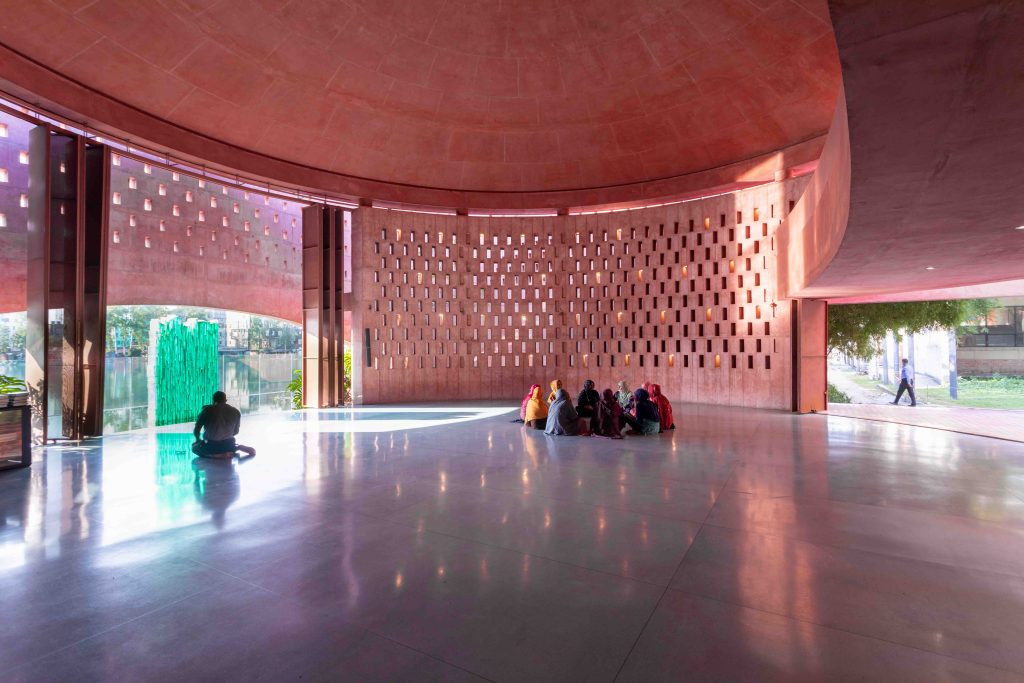
Climate-responsive design is a key feature of the mosque. Its thick concrete walls, pigmented in warm reddish tones, are punctuated with small rectangular openings that filter light and induce natural ventilation. The building “breathes,” creating a comfortable environment even in Ashulia’s hot and humid climate. The quibla, the direction of prayer toward Mecca, is highlighted by a wide arched opening in the curved wall, and the mihrab’s translucent glass pieces over the pond enhance reflection and spiritual focus.
The mosque also includes a southeast courtyard with a metal staircase that leads to an upper level for women workers. This upper level functions as both a meeting room and a prayer space. A Chhatim tree planted nearby adds a sensory experience, filling the courtyard with fragrance during its flowering season.

The Zebun Nessa Mosque has received widespread recognition beyond TIME. Meghna was honored as the Foreign Countries’ Architect of the Year at the 34th JK Architect of the Year Awards. The mosque was also shortlisted among the Top Five Civic Projects on DEZEEN and featured on ARCHDAILY as one of the Top Five Religious Projects globally. Meghna attributes this recognition to the mosque’s balance of tradition and modernity and the exceptional collaboration between architects, craftsmen, and consultants.
Speaking about the TIME recognition, Meghna said, “The Zebun Nessa Mosque is the first place in Bangladesh to be featured in TIME World’s Greatest Places. It feels incredibly rewarding to see a project from Bangladesh being noticed internationally without any external promotion. The appreciation from both national and global audiences has been humbling and strengthens my responsibility as an architect to continue creating meaningful spaces.” It was also shortlisted for the current cycle of RIBA International Award and Al Fozan Award.

This project is also a significant milestone for women in architecture. Meghna’s achievement demonstrates the impact female architects can have in a traditionally male-dominated field. Her work serves as an inspiration, showing that thoughtful design and dedication can transcend cultural and professional boundaries.

Building on the principles demonstrated in the mosque, Meghna is now working on another socially impactful project: a community space and daycare center for women garment workers inside the same industrial compound. This upcoming project continues to focus on cultural sensitivity, innovation, and accessible, low-cost materials.


The Zebun Nessa Mosque, with its thoughtful use of geometry, climate-responsive design, and integration of natural light and ventilation, is more than a place of worship. It is a powerful example of the transformative potential of architecture, a celebration of Bangladeshi craftsmanship, and a symbol of the country’s growing presence on the global architectural stage. The mosque demonstrates that architecture can inspire, serve communities, and create spaces that are both functional and uplifting.