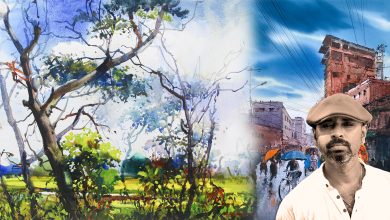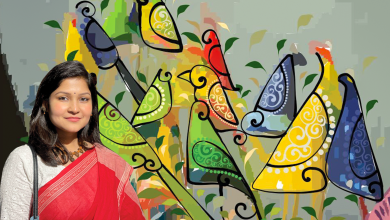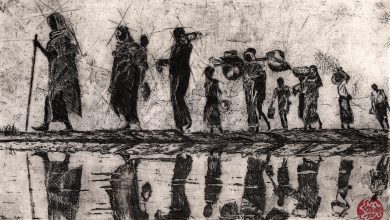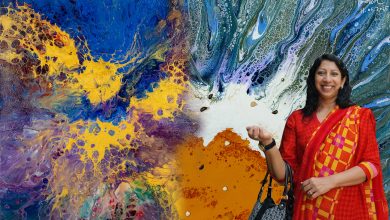
In the contemporary art landscape of Bangladesh, few voices resonate with the blend of introspection, technical clarity, and cultural rootedness as profoundly as that of Hamim Ul Zihad Sojol. Emerging from an academic background in engineering yet flourishing professionally as a fine artist, Sojol represents a rare synthesis, one who navigates the worlds of logic and emotion with equal fluency. His paintings, whether created in charcoal, acrylic, sketch, or his beloved watercolor, breathe with the rhythm of Bangladesh’s landscapes, its people, and the quiet poetry found in overlooked spaces.

From early childhood, art was his calling. Engineering, he explains, gave him structure, order, and analytical discipline, but painting offered something deeper, a way of living. “I never see an artwork as just a task to be completed; I see it as an endless journey,” he says, capturing the essence of his lifelong pursuit. That philosophy has carried him across countries, workshops, exhibitions, and countless collaborations, allowing him to gather experiences that now shape the emotional undertones of his compositions.

What distinguishes Sojol’s work is his unwavering belief that art and science are not opposites, but partners. With the precision of an engineer and the sensitivity of a painter, he examines subjects with a level of subtlety that few artists attempt. “I feel there exists an inseparable relationship between art and science. Just as science creates, so too does art,” he often reflects. This union of analytical thinking and intuitive seeing produces a striking clarity in his landscapes, portraits, and urban studies.

For Sojol, creative expression is not solely about the mastery of technique. He values perspective, philosophy, and lived experience above all. The works of Leonardo da Vinci, Michelangelo, and Picasso formed the intellectual foundation of his early artistic journey. Their relentless curiosity urged him not to imitate but to investigate,to observe the world with patience, depth, and a hunger for meaning.

Unlike many artists drawn to the picturesque, Sojol finds inspiration in the neglected corners of life. An abandoned factory, a shipyard cluttered with iron and sparks, a narrow alley in Old Dhaka where history still whispers, or the deep stillness of a remote village, these are the spaces that call to him.

“Where others see chaos, I see dialogue, between light and shadow, between progress and memory,” he explains. The play of illumination in these seemingly ordinary locations becomes, in his hands, a narrative of resilience, toil, and transformation. His long involvement in shipbuilding and urban development has allowed him a frontline view of how Bangladesh grows, shifts, and reshapes itself. From the clang of metal in a shipyard to the rising silhouettes of new cities, he witnesses firsthand the environments built by working hands, the laborers whose contributions often go unrecognized.

Moved by their stories, he paints not merely structures or landscapes, but the emotional labor embedded within them. Their shadows, gestures, and presence seep into his compositions, becoming part of a larger commentary on society, humanity, and change.

Although Sojol is fluent in multiple media, watercolor remains his most intimate companion. He sees within its transparency and fluidity a mirror of Bangladesh’s six seasons, its monsoon breaths, its soft winter haze, its sudden storms, its calm sunsets. “Watercolor speaks in the voice of our land. It carries a sense of intimacy that allows me to reach both people and nature with ease,” he says.

This bond with watercolor is not merely technical; it is emotional and almost spiritual. Through its delicate washes, Sojol explores the fragile balance between clarity and loss, memory and immediacy. Each brushstroke reveals not only the scene before him but the shifting moods of a nation shaped by nature, history, and time.
Travel has been one of the most transformative elements of his artistic evolution. Exploring every division of Bangladesh and traveling across the Asian subcontinent, Sojol immersed himself in different cultural identities, folk traditions, and urban environments. He sees culture not as a fixed artifact but as a living organism, shaped, expanded, and reinvented over centuries.
These journeys have broadened his visual vocabulary and deepened his understanding of human diversity. In workshops, seminars, and collaborative projects with schools, colleges, and universities, he discovered not only new landscapes but new minds. “Through people, I learn to see differently. Their visions give me new inspiration to create,” he reflects. Teaching, for him, is as enriching as creating; it is dialogue, exchange, and collective discovery.
A significant portion of his work highlights Bangladesh’s ancient history and the fading charm of Old Dhaka. The narrow lanes, decaying architecture, and relics of bygone eras fascinate him, not as ruins but as living testimony to thousands of years of civilization. His paintings often serve as visual reminders of what must be preserved, cherished, and remembered.
This connection to history shapes his worldview. He seeks to understand society not only through its present but through its long journey, its politics, economics, migrations, and cultural synthesis.
At the core of Sojol’s artistic philosophy lies a vision of harmony. In a world often divided by class, ethnicity, or ideology, he imagines a society where diversity does not fracture but strengthens humanity. “My dream is of a society where cultural diversity thrives without breaking the bonds of unity,” he says with conviction.
To him, art is not decorative. It is transformative. It is a bridge, linking individuals, communities, and generations. Through colors, shapes, and emotions, he believes we can build a more rational, inclusive, compassionate world.

And perhaps that is the greatest strength of Hamim Ul Zihad Sojol: not simply his skill, but his belief that art can awaken empathy, illuminate forgotten truths, and guide society toward a more thoughtful horizon.