
The Dhaka city hums outside, but inside the Hajee Air Travels, every detail seems carefully orchestrated to make movement effortless, and work feels like part of a journey rather than a task. Designed by KAAY, with architects Tansen Alam Sangit and Rafia Rukhsat, the 3,688-square-ft headquarters in New Paltan is less about corporate formality and more about the motion of people, of ideas, of journeys constantly beginning. The architects approach the project with a simple but ambitious question. How does an aviation agency translate the experience of flight into everyday work life?
“The ceiling becomes the sky, and the workspace learns to breathe.”
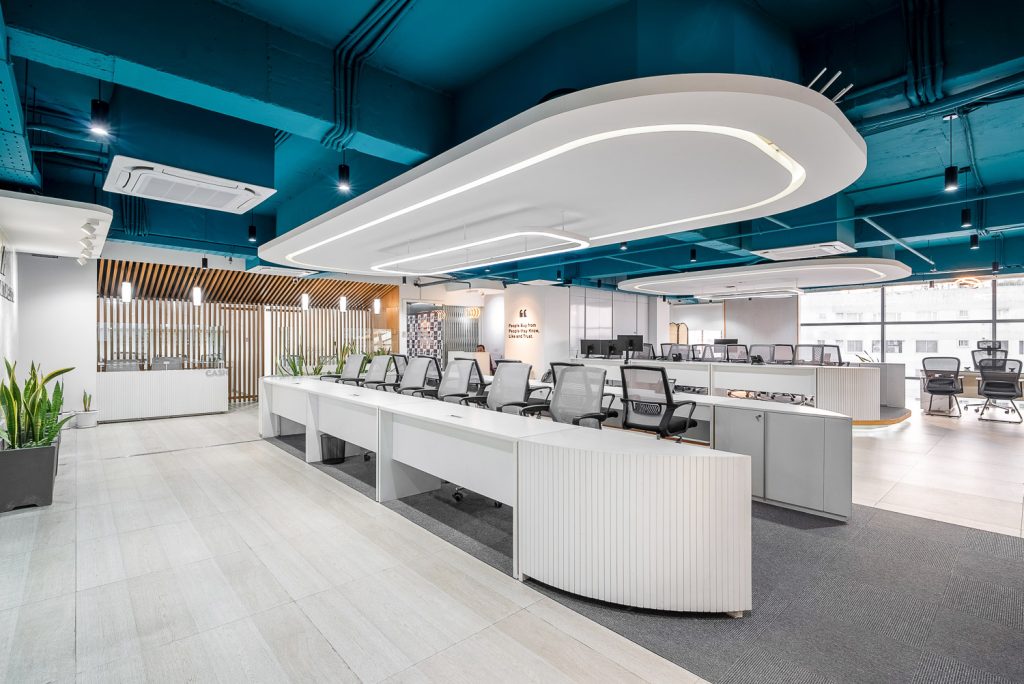
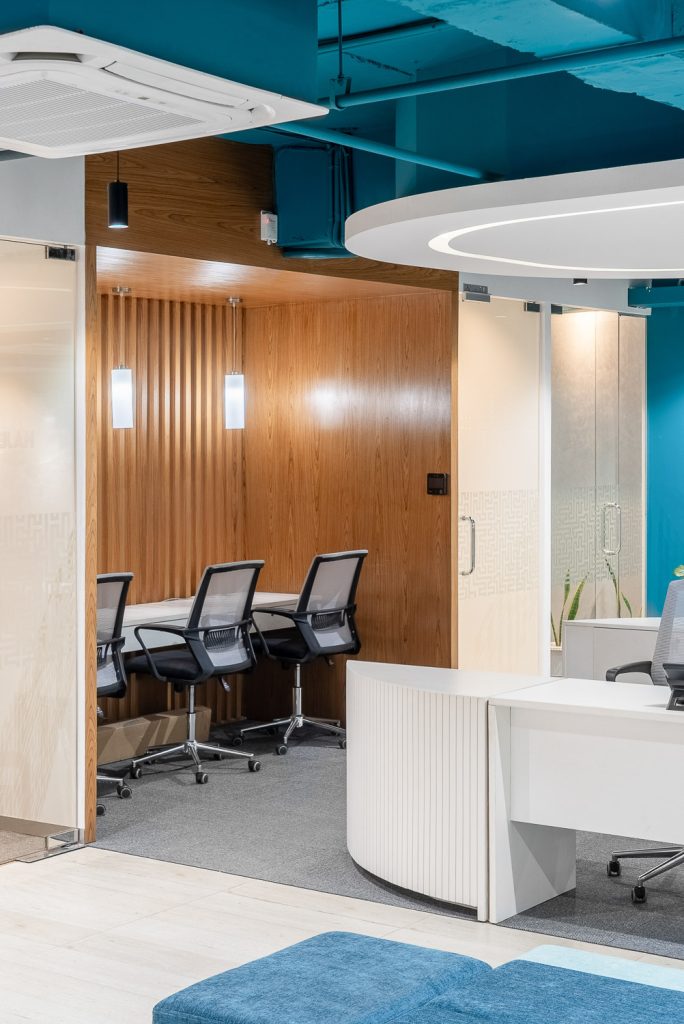
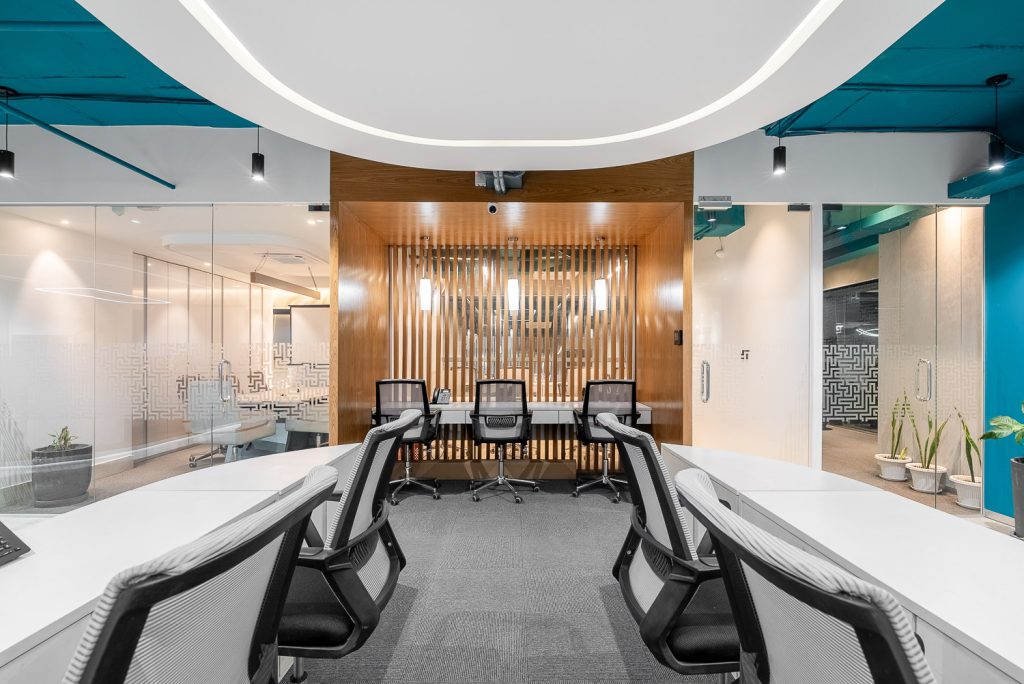
Here, the architects do not hide the building’s mechanics and technical complexity; they treat the soffit as a canvas. Exposed wiring, ducts, and HVAC systems, often banished from sight, are painted in bold cerulean, transforming industrial necessity into an honest, expressive ceiling. Above the workstations, white, cloud-like curvilinear panels float, softening the technicality below while guiding footsteps and attention. The ceiling isn’t just overhead; it is a sky, a canvas of air and light, giving the office a sense of height, openness, and possibility.
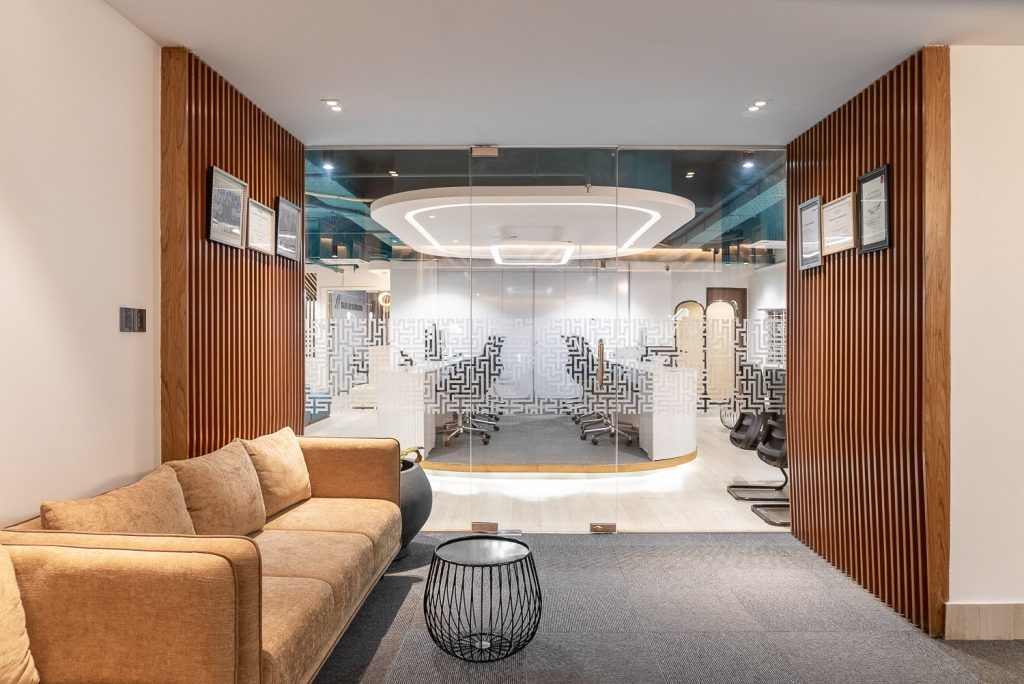
Movement continues on the floor below. Capsule-shaped workstations replace traditional desks, eliminating sharp corners and promoting fluid movement. Their forms subtly echo aircraft cabins and fuselages, reinforcing the project’s aerodynamic geometry. At the “nose” of each workstation, integrate the planters, introduce snake plants, quiet, upright, resilient. The biophilic gesture is both symbolic and practical, offering moments of green relief within long hours of ticketing, coordination, and client interaction.
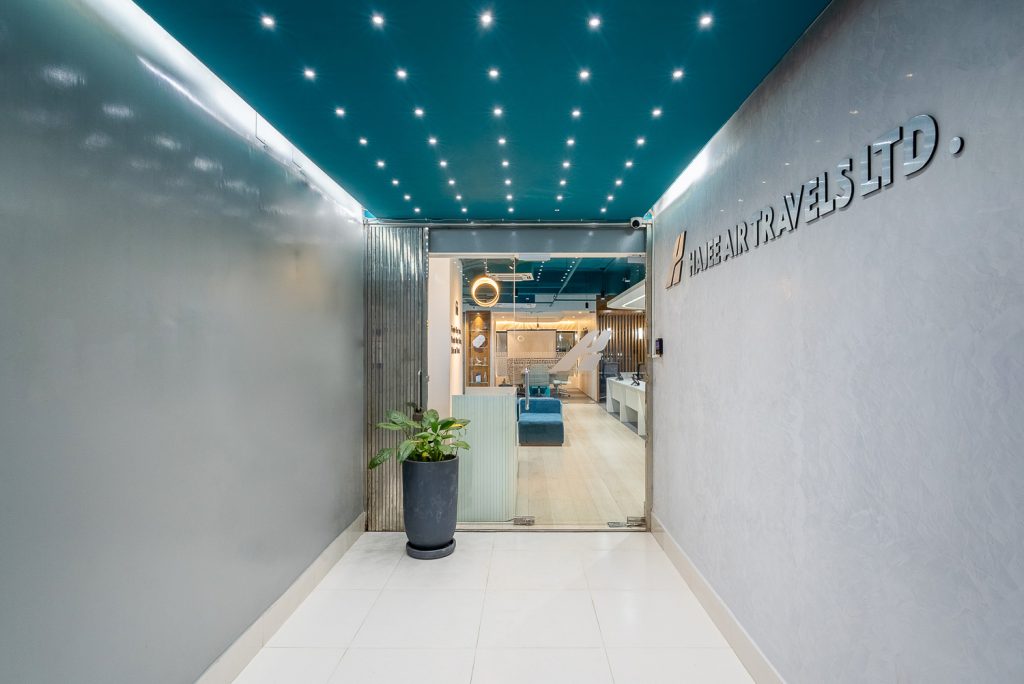
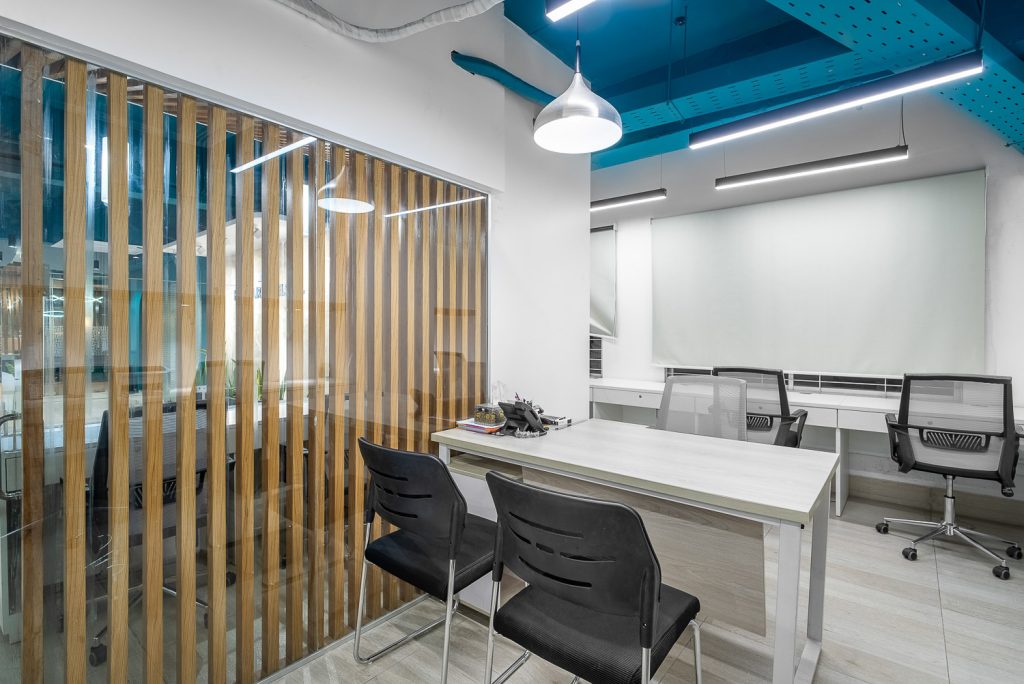
Transparency is treated not as a visual trend but as a value. Frameless glass partitions define offices and meeting rooms, detailed with geometric silk-screen patterns that strike a balance between openness and discretion. Sightlines remain uninterrupted. Whether seated at a desk deep within the plan or standing at the reception, employees share a visual relationship with the skyline beyond. In a business built on trust and logistics, this openness becomes a spatial metaphor where nothing is hidden, everything is connected.
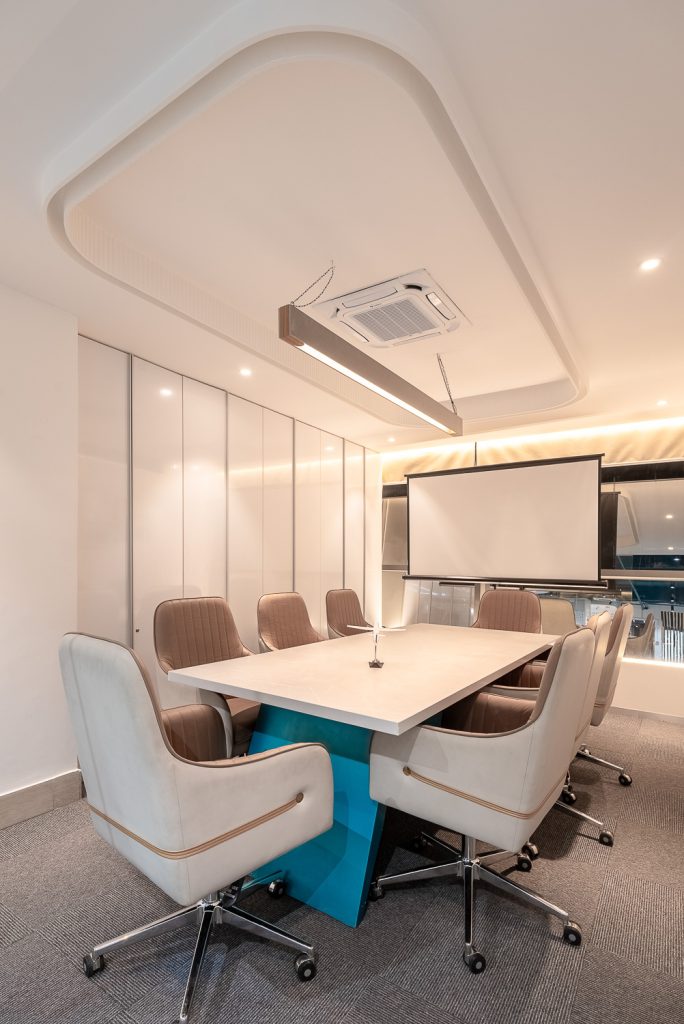
The architects liken it to moving through an airport from terminal to cabin, where each zone subtly prepares you for what comes next. Waiting areas avoid heaviness, furnished instead with modular ottomans in jewel tones that punctuate the neutral palette without crowding the space.
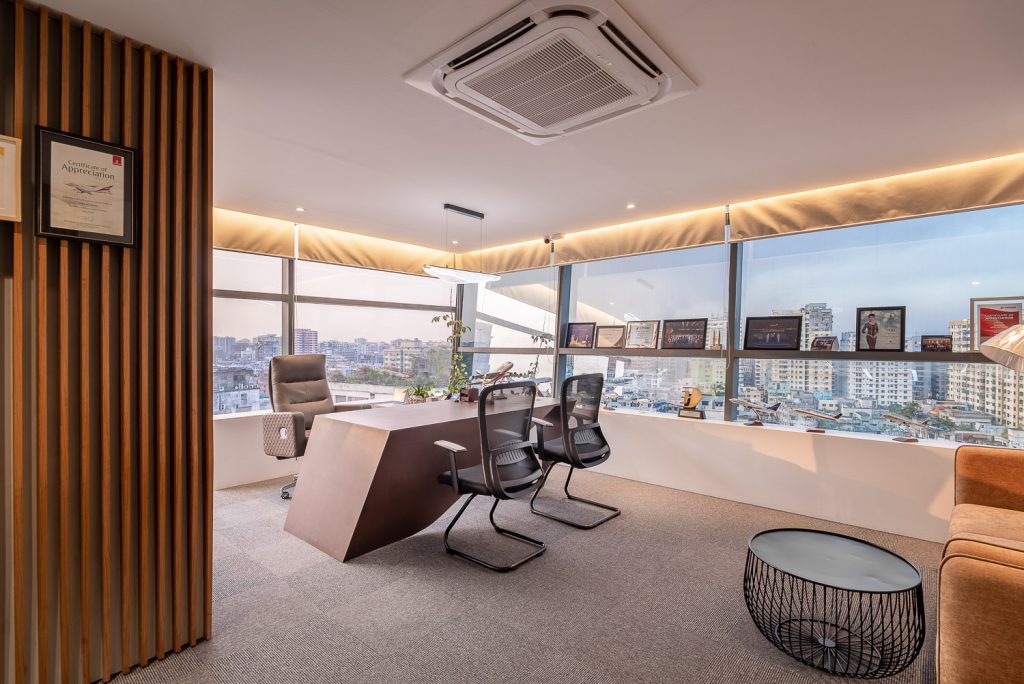
Material choices speak in quiet dialogue. Polished stone and glass establish professionalism and clarity, while vertical timber battens introduce warmth and rhythm, particularly in executive areas. Wood shelving and louvres soften the otherwise tech-driven environment, reminding occupants that efficiency does not have to feel cold.
Lighting plays a defining role in shaping mood. Recessed LED strips trace the contours of the cloud ceilings, bathing the office in a soft, ambient glow. Black cylindrical pendants provide focused task lighting, while under-desk LEDs and subtle backlighting in executive areas add depth, echoing the calm and elegance of first-class cabins in flight.
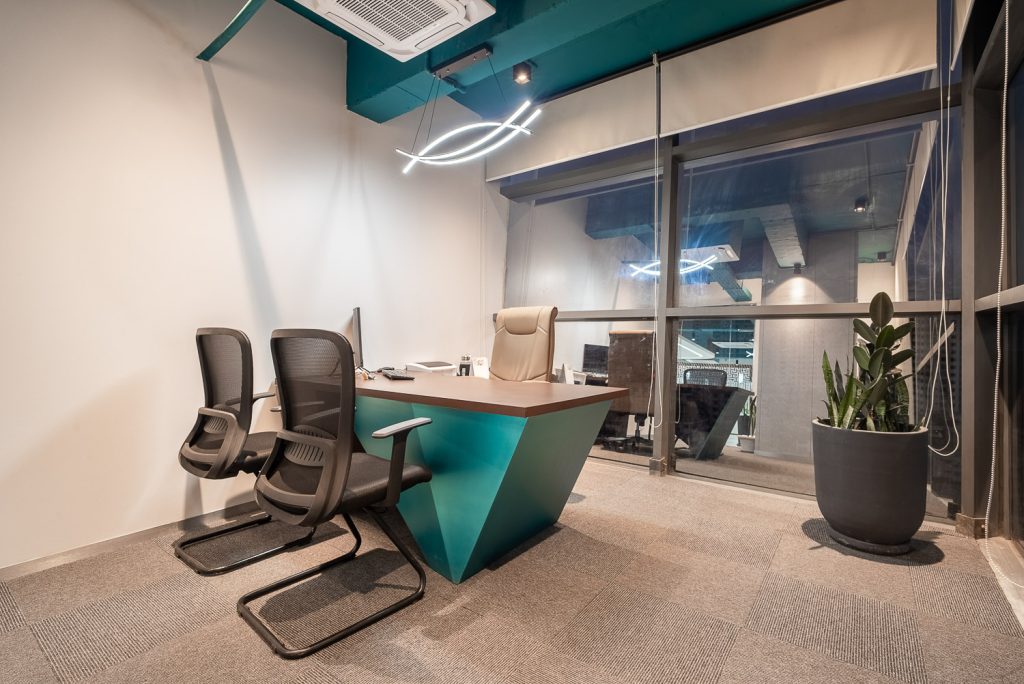
At the core of the office, the executive suite stands as a quiet anchor. The monolithic desk faces the skyline, a subtle reminder of oversight, vision, and connection. It is the captain’s seat, where decisions are made with clarity, framed by the city’s horizon, merging the operational with the poetic.
“An office, like a journey, works best when direction is clear, and movement feels effortless.”
In this project, branding is present but never literal. The deep teal ceiling references sky and sea without illustration. The fluid forms suggest motion without mimicry. Even the exposed wiring, often seen as visual clutter, becomes part of the narrative, technical, honest, and integral. The architects resist excess, allowing function to inform beauty. This is not an office trying to impress, but it is an office that knows exactly where it is going.
Ultimately, Hajee Air Travels’ office reflects a contemporary understanding of work in Dhaka, fast-paced, global, yet deeply human. The space acknowledges long hours and complex operations, responding with light, openness, and moments of calm. Plants offer visual resets. Rounding forms ease movement. Views remind occupants that their work connects people to places beyond these walls.
“Design is not decoration, it is the invisible rhythm that guides how we move, work, and feel.”
This is not an office that asks employees to sit still. It encourages flow between desks and departments, between clients and consultants, between ground and sky. In translating the fluidity of flight into architectural language, the project achieves something rare: a workplace that feels both efficient and expansive, rooted in the city yet always looking outward.