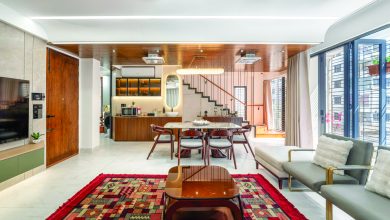
Dhaka is a city that never stops moving, and neither does DIGIFEA. Tucked into a compact floor plate along Mirpur Kazipara, the company’s new headquarters for this software-driven company feels less like a conventional office and more like a living system, one that flows, adapts, and responds to its people. Designed and implemented by Architect Mozammel Hoq Jafor & Architect Humaira Binte Hannan, Studio One Zero for DIGIFEA’s design-driven culture, the 5,500-square-ft workspace accommodates 120 professionals without ever feeling cramped. Instead, it remains intentional, alert, and quietly energetic.

This is not an office built around desks. It is built around movement.
The architects begin with a clear understanding: today’s workplace, especially under Gen-Z leadership, no longer thrives on rigidity or hierarchy. Productivity no longer emerges from silence and symmetry alone; it grows from interaction, freedom, and spatial clarity. DIGIFEA’s office embraces this shift by treating space as a journey rather than a container.

“Circulation is no longer leftover space; it is the backbone of work.”
At the heart of the plan lies a road-inspired circulation spine, a blue pathway that cuts through the office like an urban street. It is both conceptual and functional connecting workstations, meeting rooms, collaboration zones, and social pockets. This spine is not decorative; it is directional. It orients users, organises movement, and quietly mirrors the iterative nature of software development, constant motion, consistent direction, and forward progress.

The moment of entry sets the tone. One does not simply step into DIGIFEA; one is absorbed into it. The spatial choreography begins immediately, immersing employees and visitors into the brand’s culture of energy and momentum. Productivity, here, does not wait for the workstation; it begins at the threshold.

Visually, the office resists corporate monotony. Colour becomes a narrative tool rather than an accent. Inspired by urban life and city movement, the palette shifts across the plan, marking transitions and emotional cues. Blues ground the circulation, neutrals calm the work zones, and bolder hues appear in breakout areas signalling moments of pause, play, and exchange. The design speaks of a workplace moving from hierarchy to fluidity, from formality to play.

Above, the ceiling is deliberately left open. Services HVAC, electrical, and fire are exposed yet disciplined, painted in darker tones to visually lift the ceiling plane. This decision does more than reduce cost; it expands perception. The office feels taller, lighter, less confined. Linear fins and geometric LED lighting float overhead, reinforcing direction and rhythm while acting as visual wayfinding. Light does not merely illuminate; it guides.

Workstations are modular and tightly planned, built with pre-laminated boards and powder-coated metal frames. The cluster layout allows high density without visual chaos, ensuring ergonomic comfort for long working hours while minimising material waste. Power and data are seamlessly integrated, supporting uninterrupted software operations without cluttering the workspace.
Glass partitions frame conference rooms, manager cabins, and training areas. Clear and frosted films balance transparency with privacy, allowing light to travel freely while maintaining focus. Acoustic strategies, such as carpet tiles, sealed glass partitions, and localised ceiling treatments, ensure that, despite the density, the office remains calm and composed. Sound is absorbed, not amplified.

Breakout zones soften the intensity of work. Here, soft furniture, vinyl and epoxy flooring, and informal layouts invite conversation and mental reset. Motivational graphics appear not as decoration, but as quiet affirmations reinforcing organisational culture without shouting.
“Design here is not about expression alone, it is about performance with empathy.”

This balance between performance and well-being defines the project’s architectural value. Every square foot serves a purpose. There is no dead space, no visual excess. In architectural terms, this office proves a quiet point: density does not have to dilute experience. Circulation can be a design driver. Branding can coexist with restraint. Performance can live alongside poetry.

DIGIFEA Headquarters ultimately reflects a contemporary truth: work today is fluid, fast, and deeply human. This office does not ask people to adapt to space. Instead, space adapts to the way people think, move, collaborate, and grow. In a city built on motion, DIGIFEA’s workplace finds clarity within movement and turns density into direction.